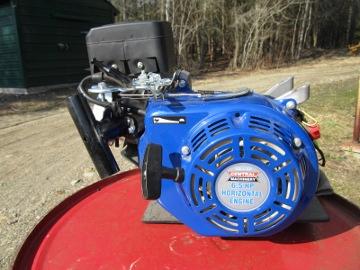
Conversion of a 6.5hp single cylinder Honda clone engine to producer-gas. Timing was advanced and a carburetor was fabricated. These are affordable engines popular with go-cart racers thus there is a pool of performance techniques easily available to tap.
Distributed Power from GE has more than a century of combined experience in gas turbines and gas engine technology with our aeroderivative gas turbine, Jenbacher gas engine, and Waukesha* gas engine product lines.
Gas engines for natural and man-made / waste gases
Gasifier and Engine Tables
Kevin Chisholm, October 11, 2006
Attached is a Spread Sheet "Gasifier and Engine Tables" that should answer a number of questions relating to diesel fuel displaced by using wood gas in a dual fueled engine, or the amount of wood required to provide sufficient gas to run a Spark Ignition (SI) engine of any size.
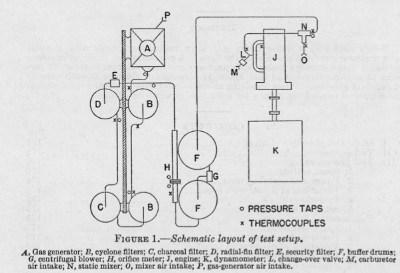
Bench tests with a four-cylinder stationary engine were made with gasoline
and producer gas from charcoal as the fuels. A comparison of their performance
revf'aled that maximum power from producer gas from charcoal is about 55 per-
cent of gasoline power, and that about 11.4 pounds of charcoal is equivalent to
1 gallon of gasoline. When operating an engine on producer gas the spark should
be advanced beyond the setting for maximum power with gasoline.